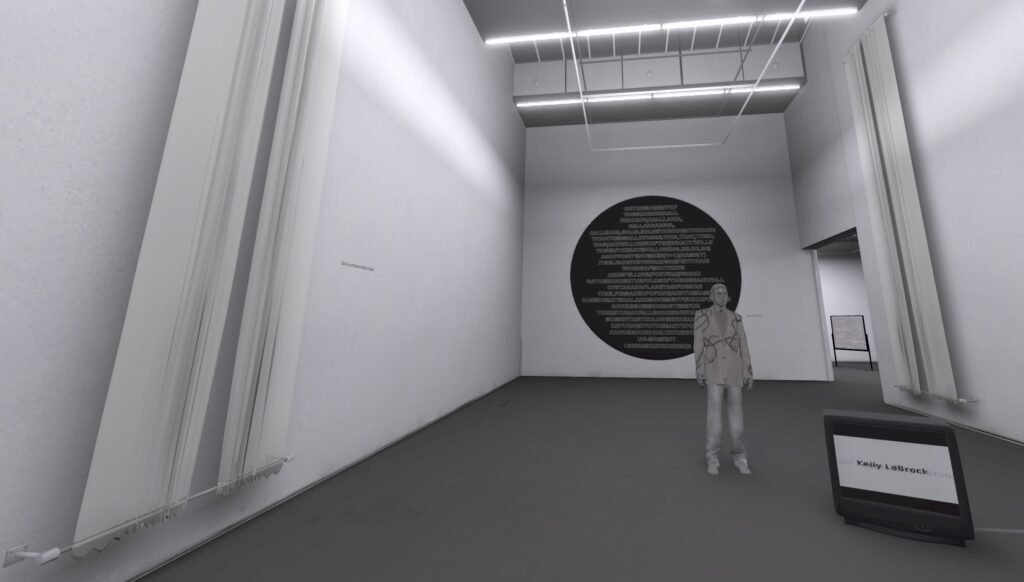
We Are Only Partly Real, 2025
VR Installation Shot, Zone 3 Day Cycle
‘Walking in My Mind’ exhibited at the Hayward Gallery, from Jun – Sept 2009, presented what the curators Stephanie Rosenthal and Mami Kataoka refer to as; ‘gigantic…individual mindscapes’, that invited the viewer to explore ‘the inner workings’ of ten artists ’emotions, thoughts, memories and dreams’, which they described as forming a ‘collision’ between ‘inner and outer space’.[1]
In the preface of the publication that accompanied this exhibition, the gallery director Ralph Rugoff draws from the ‘immersive’ nature of each installation as encouraging the viewer to form their own ‘awareness’ to ‘…the broader cultural context in which we live’, wherein, ‘different mental paths and ways of processing information’ can be discovered. [2]
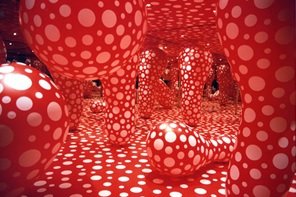
Dots Obsession, 2009, by Yayoi Kusuma
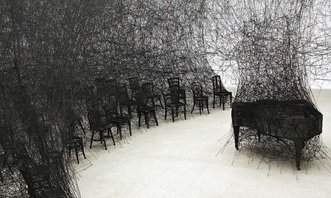
In Silence, 2009, by Chiharu Shiota
In an interview titled; ‘We are never out of place, wherever we may be’ [3] between Silvia Calvarese and RAQS Media Collective [4], Calvarese opens the interview by reflecting upon what it means to feel into a space.
Using the metaphor of ‘desire’ to explore the transformative nature of a place that cannot be physically occupied, Calvarese reflects on the online academic journal that RAQS created, titled Sarai [5], as a ‘portal’, a ‘virtual space’ and a universal landscape, wherein, people can meet to discuss ‘shared issues’, and frames the following question to RAQS;
Unlike “physical” places, there are here several realities gathered together in one space only, and it makes the discourse space out. In this respect, is it about a global issue analysed from different “local” points of view, or is it that each and every topic comes from local realities and they merge together in order to give shape to a new “global”, heterogeneous and shared topic?
…to which, RAQS respond;
Sarai is a physical as well as a conceptual space. And it is committed to transcending the false categorical distinction that privileges either local or global vantage points. The point is to think the world in every place, and to be committed to what is unique and distinctive in every part of the world. This means a certain ambidexterity when it comes to spatial commitments, a willingness to be both anchored as well as airborne.
Forming a connection between The Promise of a Scattered Methodology and Sarai, which both explore knowledge as a collective journey to be discovered, RAQS refer to the biblical etymology of the name Sarai (which God renamed to Sarah, meaning the ‘mother of nations’) when describing Sarai as an online ‘archive’ and a ‘chronicle of multiplication’, wherein, an ‘intersection of journeys’ and a ‘network of possibilities’ can take place.[5]
Continuing the interview, Calvarese refers to ‘Now-here, the present time and no-where, the absent place, the unreal and not existing place’ as an ‘anywhere, near or far’, redefining ‘where’ not as a physical place, but a ‘feeling of being home’.
RAQS responds to Calvarese’s association of the word ‘desire’ in relation to their video-work ‘The Capital of Accumulation’, from 2012, paying reference to a ‘fugitive’ as opposed to a ‘conqueror’, using the spatial metaphor ‘reservoirs of hope’.
Calvarese then refers to a line from their video, asking if RAQS could explain more about the following passage;
…the mountain falls on its knees, the desert becomes a mirage, the sea runs dry, the city opens its boundaries and gets wide…
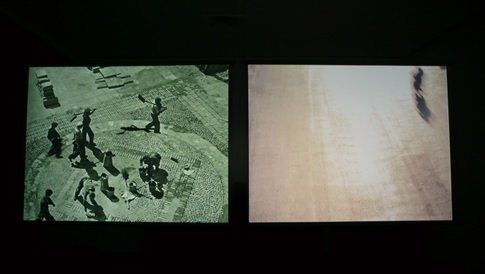
Video still taken from The Capital of Accumulation, 2010, by Raqs Media Collective
Referring to Luxme Sorabgur as a fictional character, whom, in this video-work traces the journey of Rosa Luxemburg; the Polish-Jew philosopher and anti-war activist, RAQS responds;
We are free to choose the paths that earlier histories of migration and foraging have opened up…One name twists and turns into another. That is a bit like a grateful traveller trying on a pair of thoughtfully left-behind shoes. Rosa Luxemburg used to say that she could change nationalities as often as she changed shoes, and she liked changing shoes. The traces of her journeys are marked by the way she could play at being in the world. Refusing to abide by the limits of what it meant to be a Pole, or Jew or Woman or Militant or Intellectual. That refusal to be contained in any way is what we aspire for in our practice. One can keep stepping into the shoes of the other in order to find one’s way.[6]
From July to Sept 2016, RAQ’s Media Collective were commissioned to create a temporary, public work at The Brayford, in Lincoln, in which they responded to the birthplace of George Boole, by abstracting Boole’s ‘logic gates’[7], which explored an alternative to the binary nature of logic, in a sculpture titled ‘Perhaps (An investigation outside the laws of thought)’.
Described by the Curator Jeanine Griffin as ‘Two arcs’ that ‘rise and fall’, through which, ‘reflective surface[s]…mirror each other, the water and their environs, creating an illusion of a fold in space’, she refered to these arcs as ‘portals’ and ‘conceptual sites of entry and exit for answers to questions that can end in either a yes or a no answer’.[8]
In the accompanying lecture to support the launch of this commission, Monica Narula represented the RAQS Media Collective and defined the structural form of the two arcs as ‘propping each other up’, as if they were unable to ‘stand independently’. Narula described the arcs as being ‘nested’ to allow for the possibility of simultaneously entering both the ‘yes’ and ‘no’ gates of logic simultaneously, without the need to change one’s direction. Further describing the sculpture as being ‘reflective, not definitive’ and as ‘blurry…forms that break certainty’, Narula ascertains how ‘Perhaps’ was a physical and conceptual space that was created to make room beyond the boundaries of ‘yes’ and ‘no’.
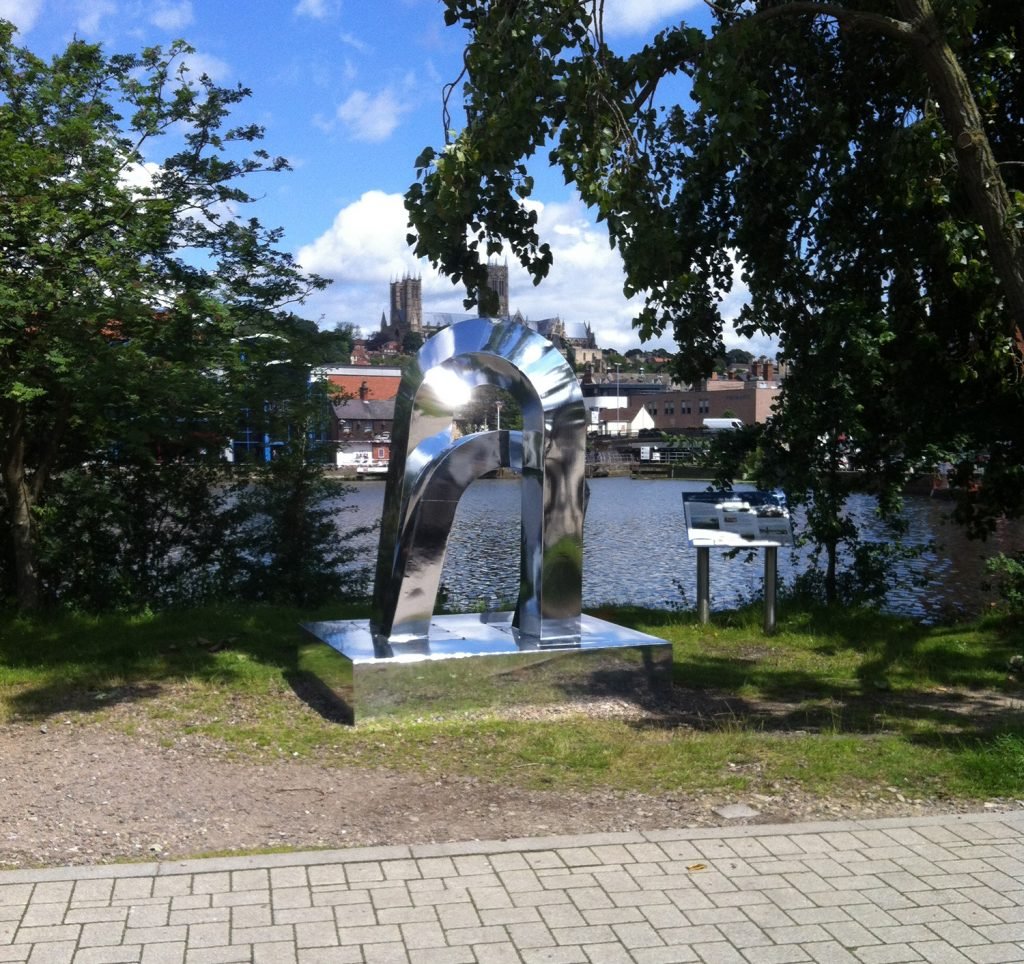
Perhaps- An investigation outside the laws of thought, 2016, by RAQS Media Collective
On reflection of the limits of binary thinking; right/wrong, yes/no, good/bad, start/finish, happen/not happen, it is clear that these mutually exclusive options hold a directional and manageable option with which to form decisions, through which we can measure performance, but if we were to consider holding the tension between simplistic and reductive black and white thinking, breaking down their unity and synthesizing the conflict between them, we could expand on our responses, permitting exploration of the murky, grey areas, to move between multiple experiences, mediate rivalry and transcend polarisation, forming an emotional intelligence, with which to empathise with interpersonal relationships.
[1] Mami Kataoka & Stephanie Rosenthal. ‘Walking in my mind’. Online Source: http://walkinginmymind.southbankcentre.co.uk/index. 2009. Source cited: June 2016
[2] Ralph Rugoff. ‘Walking in My Mind’. London: Hayward Publishing. 2009. p6.
[3] Silvia Calvarese, RAQS Media Collective. ‘We are never out of place, wherever we may be: Roots – Routes Research on Visual Cultures’. Issue.23 Sept-Dec 2016. Online Source: http://www.roots-routes.org/?p=5325. Source cited: Oct 2016
[4] RAQS Media Collective are Jeebesh Bagchi, Monica Narula & Shuddhabrata Sengupta
[5] ‘Sarai’ is an online academic journal, developed in 2000, initiated by Ravi Vasudevan, Ravi Sundaram and the Raqs Media Collective
[6] ‘The Holy Bible’. New International Version 2011. Genesis 17:15
[7] George Boole. ‘An Investigation into the Laws of Thought’. Watchmaker Publishing. 2010
First published in 1854
[8] Jeanine Griffin. ‘Raqs Media Collective Perhaps (An Investigation Outside the Laws of Thought)’. Online Source: http://gymnasium-projects.org/next-commission-raqs-media-collective/. 2016. Source cited: Sept 2016