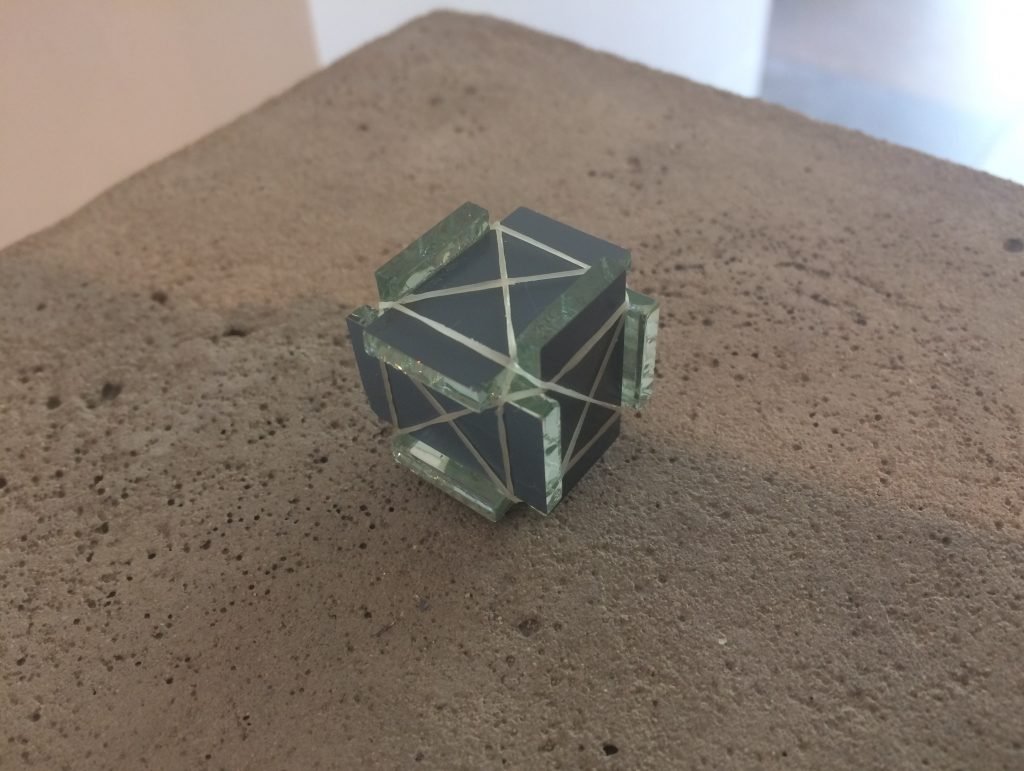
Dimensions: 2.6cm W x 2.6cm x H x 2.6cm D (infinity cube), 20cm W x 80cm H x 20cm D (concrete plinth)
Materials: Mirrors, orthodontic bands, concrete
In 2017, I was invited to exhibit in a group show titled Punctuated³. The gallery had been divided into thirteen different-sized sections, randomly allocated to each participating artist, with the directive to create new work tailored to those exact dimensions. The size of the space was the only parameter: each area was one-third the size of the previous one, resulting in artworks that ranged from over two meters to just under three centimetres.
When allocated the smallest space—a 2.6 cm cube—I initially thought I had drawn the short straw. However, recalling Michelangelo Pistoletto’s Metrocubo d’infinito (Meter Cube of Infinity), which I had seen in A Lesson in Sculpture with John Latham at the Henry Moore Institute in 2016, transformed this constraint into conceptual freedom.
Pistoletto’s infinity cube belongs to a series begun in 1966—a key precursor to Arte Povera’s radical use of humble, everyday materials. Constructed simply from rope and six inward-facing mirror panels bound together, it forms an enclosed one-meter cube of infinity that can only be reflected upon mentally.
While attempting to recreate the construction process of Pistoletto’s cube in miniature form, it dawned on me that my scaled-down piece harnessed an equally infinite internal chamber, so I titled the work Concentrate, to play on the term as a physical action, a spatial state, and a mental process. While Pistoletto bound his mirrors with rope, I used tiny, elasticated orthodontic bands designed to degrade over time.
On occasion, it has taken up to four years for each of the orthodontic bands to start disintegrating and snap. Where Pistoletto’s performances shattered his infinity cubes with an external blow—an immediate, theatrical rupture—Concentrate relies on an intrinsic, material collapse. By letting the tension dissolve over time, the work moves away from sudden disruption to reflect the reality of patience and incremental change required to erode and reform institutional systems from within.