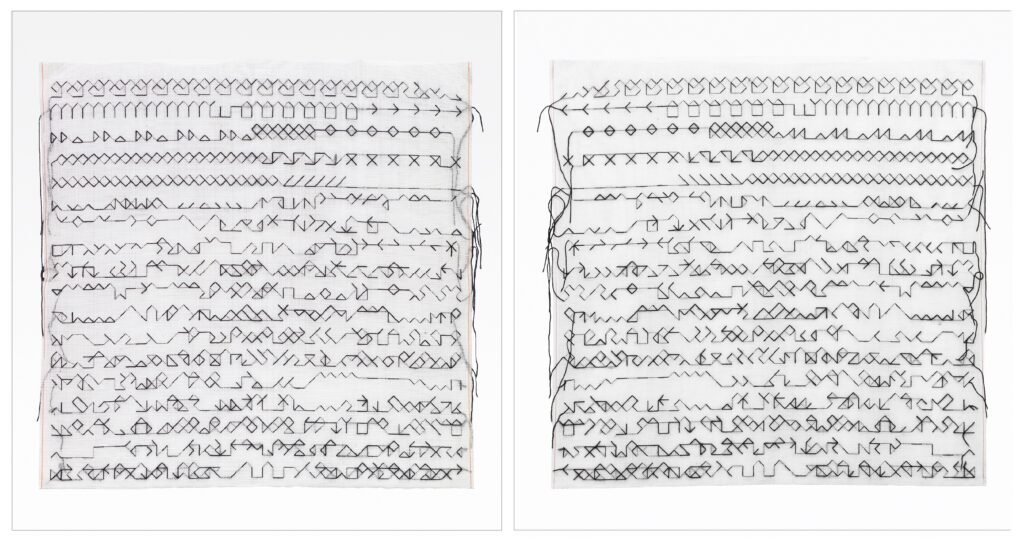
c0de to Home: A Series of one Liners (recto / verso), 2024
Materials: Embroidery canvas, yarn
Dimensions: 94cm W x 94cm H
Photo Credit: Dan Weill
The term ‘collapsology’ was coined by Pablo Servigne and Raphaël Stevens in their 2015 essay, Comment tout peut s’effondrer (How Everything Can Collapse). Their exploration of systemic fragility resonates deeply with my own practice, which centres on the constant cycle of building and rebuilding.
In At Work in the Ruins: Finding Our Place in the Time of Science, Climate Change, Pandemics, and All the Other Emergencies (2023), Dougald Hine refers to the application of collapsology as leaving “good ruins…clues and starting points for those who come after, that they may use in building a world that is presently unimaginable’ [1]. Drawing on Swedish playwright Anders Duus’s assertion that artists should ‘complicate matters,’ Hine clarifies that this isn’t about being difficult for its own sake. Rather, it is an effort to ‘do justice to the strangeness and the messiness of life.’ To Hine, art should never be reduced to a mere ‘tool to get across a message,’ nor should it function as a ‘cheap alternative to an advertising agency’ or a ‘sophisticated extension of the communications department’.
[1] Hine, D. (2023). At Work in the Ruins: Review. Online source: https://www.resilience.org/stories/2023-02-14/at-work-in-the-ruins-review/. Source cited: 2nd February 2026.
[2] Hine, D. (2023). At work in the ruins: Finding our place in the time of science, climate change, pandemics, and all the other emergencies. London: Chelsea Green Publishing. p163.