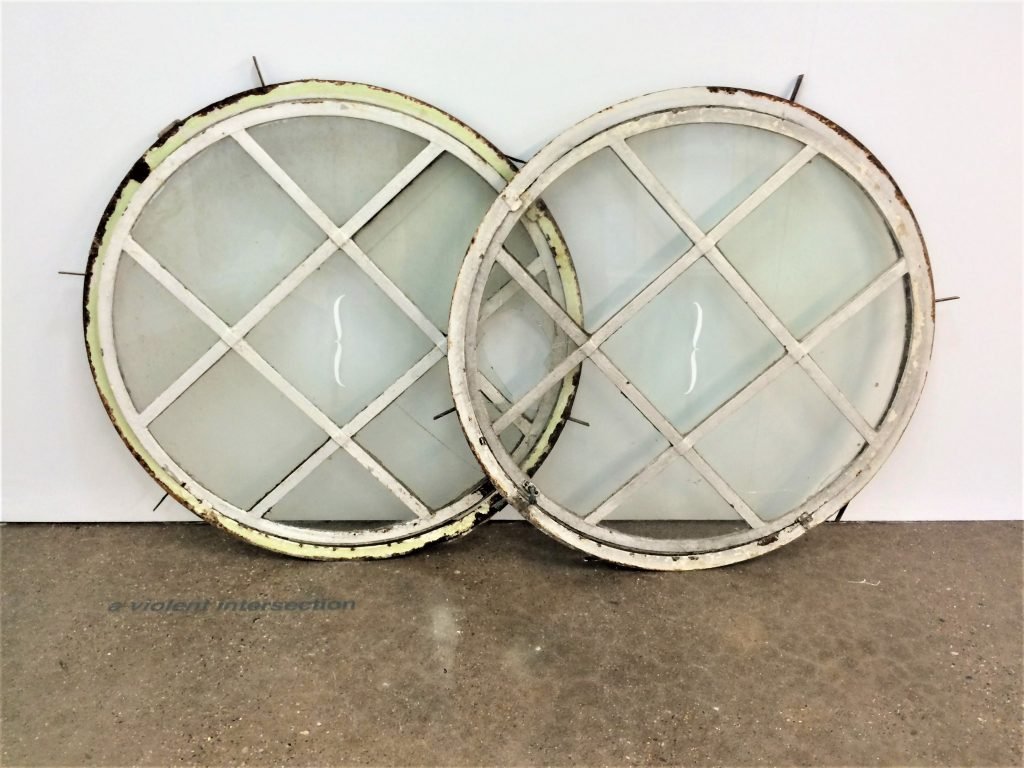
180cm x 110cm x 30cm
Reclaimed windows, enamel sign writing
In the essay What Might Have Been Is Not What Is, by Robyn Warhol, from the book Counterfactual Thinking – Counterfactual Writing, published in 2011 [1], Warhol distinguishes how a psychologist may require to ‘yield’ to ‘the power of counterfactual scenarios’ and ‘blend…conflicting situations’ to gain ‘insights into the causes of actual outcomes’. [2]
{a violent intersection}, 2017, plays with the term ‘counterfactual’ through a performative statement that is neither true nor false but embodies time as a physical force, as a mathematical factor and a philosophical conundrum.
[1] Birke, D. et al. ‘Counterfactual Thinking – Counterfactual Writing’, Berlin/Boston. 2011.
In the book Counterfactual Thinking – Counterfactual Writing, the editors Dorothee Birke, Michael Butter and Tilmann Koppe form an interdisciplinary exchange across psychology, philosophy, historiography, political sciences, linguistics, physics and literary studies, bringing together a collection of essays to explore how these different fields of study relate to the term counterfactual.
[2] Warhol, R. ‘What Might Have Been Is Not What Is’ in ‘Counterfactual Thinking – Counterfactual Writing’, edited by Birke, D. Butter, M. Koppe, T. De Gruyter: Berlin/Boston 2011, p227-239.