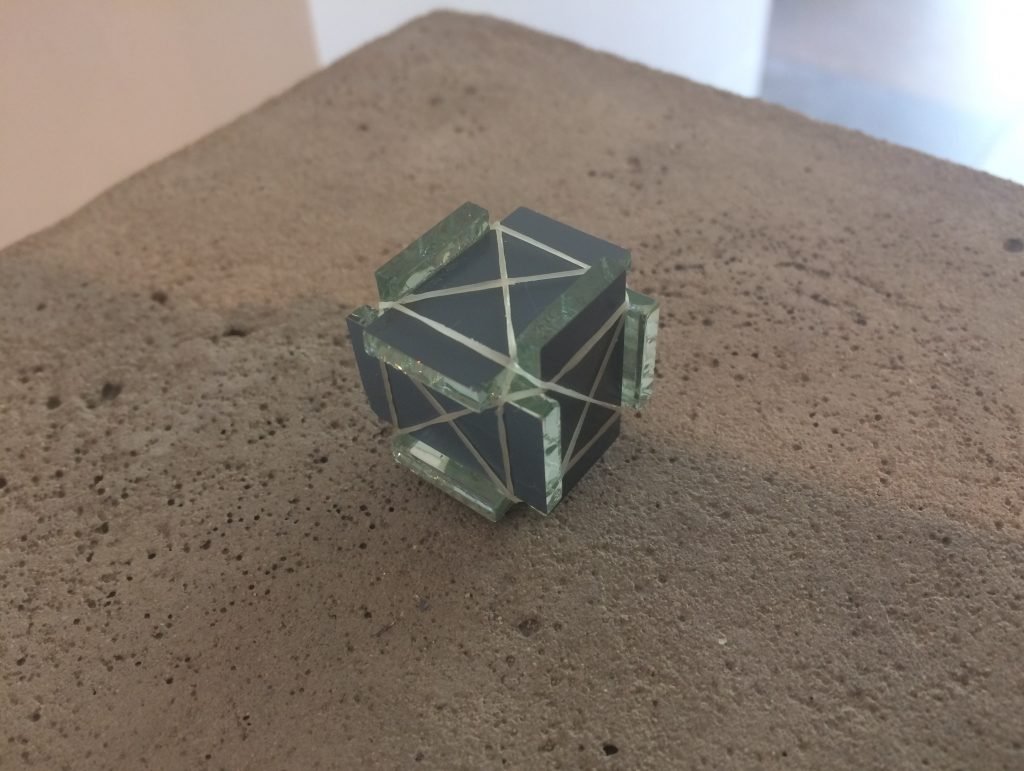
Concentrate: Pistoletto’s Infinity Cube, 2017–ongoing
Dimensions: 2.6cm W x 2.6cm x H x 2.6cm D (infinity cube), 20cm W x 80cm H x 20cm D (plinth)
Materials: Mirrors, orthodontic bands, concrete
Solitude is a condition of peace that stands in direct opposition to loneliness. Loneliness is like sitting in an empty room and being aware of the space around you. It is a condition of separateness. Solitude is becoming one with the space around you. It is a condition of union. loneliness is small, solitude is large. loneliness closes in around you; solitude expands toward the infinite. loneliness has its roots in words, in an internal conversation that nobody answers; solitude has it’s roots in the great silence of eternity.
Nerburn. K. ‘Simple Truths: Clear & Gentle Guidance on the Big Issues in Life’.
New World Library.2005. p55
Referring to her last major work; The Life of the Mind, by Hannah Arendt, which remained incomplete at the time of her death in 1975 and posthumously published in 1978, Arendt reflects upon loneliness and an inner ‘dialectical’ criticality, through which, in solitude, we must learn to turn to another part of the self, as that which;
…comes about when I am alone without being able to split up into the two-in-one, without being able to keep myself company…It is this duality of myself with myself that makes thinking a true activity, in which I am both the one who asks and who answers.[1]
In relation to the article How to Be Alone: An Antidote to One of the Central Anxieties and Greatest Paradoxes of Our Time, published online, in 2014, by Maria Popova, though Popova defines ‘voluntary aloneness’ as a choice, she reflects upon feelings of self-doubt and its impact upon solitude in the text How to Be Alone, also published in 2014, as part of The School of Life series, by Sara Maitland.
Popova references Maitland, who warns the solitary volunteer to be mindful and self-aware while undertaking acts of solitude, contending ‘…the very nature of happiness, be something I think I feel but don’t really feel’ and refers to Maitland as having built a ‘toolkit’, through five points, which have been formed as a guide, so we can learn to think through feelings and ‘do’ solitude well’;
- A deeper consciousness of oneself
- A deeper attunement to nature
- A deeper relationship with the transcendent (the numinous, the devine, the spiritual)
- Increased creativity
- An increased sense of freedom
Referencing Maitland, Popova regards the ‘outward-looking’ nature of society as a symbol of ‘status’, ‘mastery and independence’ and ‘self-assertion’, which she considers to be an imbalance in relation to solitude, which Maitland describes as having been dealt ‘…a serious social and psychological problem’ and a ‘weak logic’, in which ‘…autonomy, personal freedom, fulfilment and human rights, and above all individualism’ that is expressed through solitude, is ‘treat with a dark suspicion’. Stressing the concern of solitude as being attributed to the ‘eccentric’ nature of a solitary persons ‘well-being’, Popova highlights how Maitland refers to the fear of solitude as ultimately being driven by those ’terrified of being alone’.
Throughout this article, Popova highlights that there is a ‘stigma’ attached to people who choose to ‘elect’ their own solitude, which she contends as having created a ‘very deep cultural confusion’. Referring to a letter written by the philosopher Martha Nussbaum as a ‘…case for the importance of cultivating a rich inner life’, she notes how this letter encourages one to embrace ‘vulnerability’ and to ‘not fear feelings’, to consider ‘being intimate with our own inner life’ and explore the freedom of ’emotional excess as a generative force’, through which, we can ‘harness the empathic power of storytelling’ and enable one ‘to reach greater, more dimensional intimacy with others’.
Ultimately, Popova defends solitude as being ‘absolutely essential for a full life’ and defines ‘active aloneness’ as the seeking of ‘our own fulfilment, to act on our feelings, to achieve authenticity and personal happiness’, which she states ‘doesn’t make us more antisocial but to the contrary, better able to connect’.[2]
[1] Hannah Arendt. ‘The Life of the Mind’. New York: Harcourt, 1978, p185
[2] Maria Popova. ‘How to Be Alone: An Antidote to One of the Central Anxieties and Greatest Paradoxes of Our Time’. Online Source: https://www.brainpickings.org/2014/09/03/how-to-be-alone-school-of-life/. Sept 2014. Source cited: 10th Oct 2015.