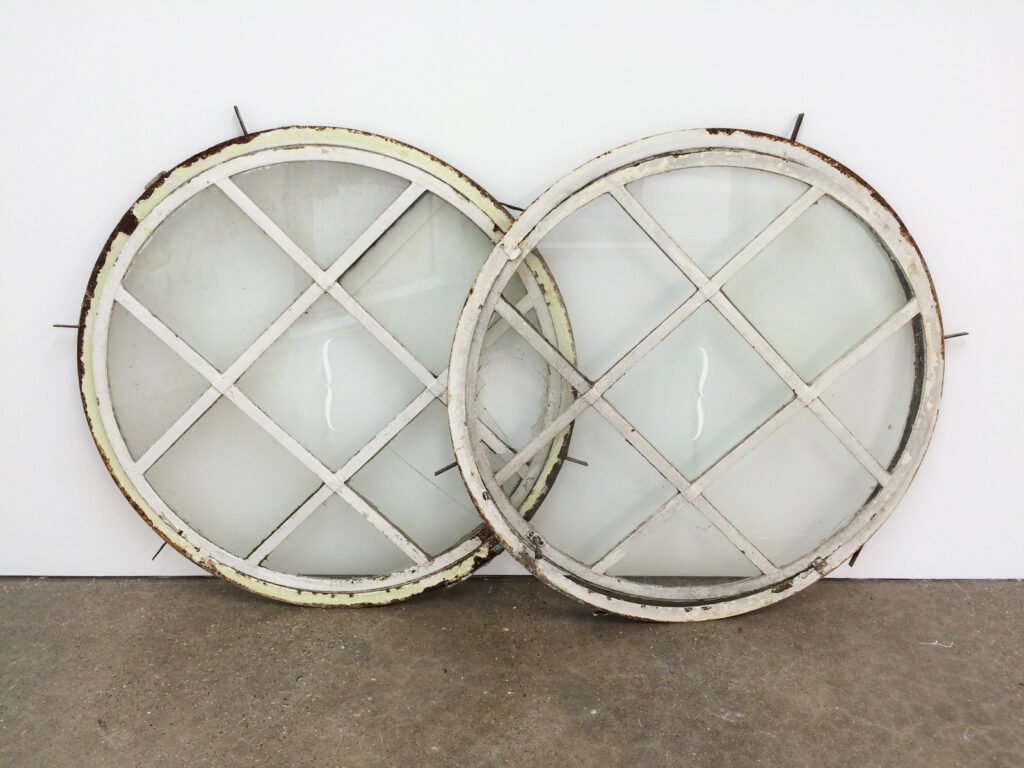
{a violent intersection}, 2017
180cm x 110cm x 30cm
Reclaimed windows, enamel sign writing
{a violent intersection}, 2017
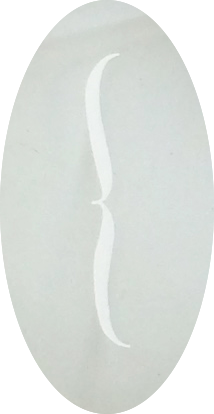
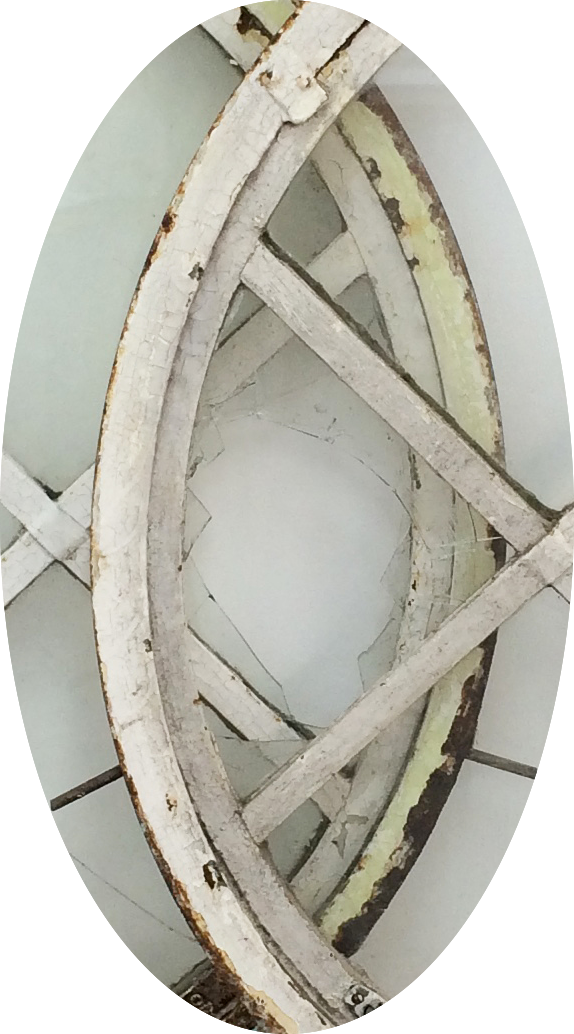
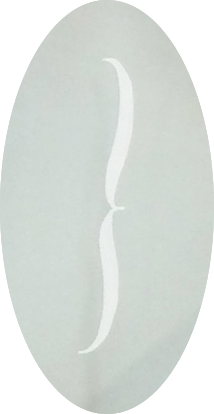
Detailed shots of hand-painted left and right curly brackets and the overlapping broken window panes
The sculpture {a violent intersection} utilises two overlapping, weathered circular window frames to construct a literal, three-dimensional Venn diagram. On the glass of the left frame, a hand-painted opening curly bracket { is visible, while a closing curly bracket } mirrors it on the right. In mathematical set theory, these brackets enclose a set—defining a boundary around a collection of elements. At the centre, where the two circles overlap, is the mathematical intersection, symbolised in set theory by the arch-like symbol ∩. In this zone of shared commonality, the glass is shattered and broken, transforming a clean, logical mathematical concept into a site of physical trauma and tension.
By combining the rigid logic of mathematics with the fragility of broken glass, {a violent intersection} plays with the term “counterfactual” through a performative statement that is neither true nor false, but a physical force and a philosophical conundrum or paradoxical problem, which lacks a definitive, factual solution. This physical blending of conflicting situations mirrors the interdisciplinary ideas explored in the volume Counterfactual Thinking – Counterfactual Writing, edited by Dorothee Birke, Michael Butter, and Tilmann Koppe, which investigates how fields from psychology and philosophy to physics and literary studies relate to what might have been. In her essay “What Might Have Been Is Not What Is,” literary theorist Robyn Warhol distinguishes how a psychologist may require us to “yield” to “the power of counterfactual scenarios” and “blend… conflicting situations” to gain “insights into the causes of actual outcomes”. By confronting this broken intersection, the viewer is forced to yield to this very tension—suspended between the physical reality of what is, and the ghost of what might have been. [1]
[1] Warhol, R. ‘What Might Have Been Is Not What Is’ in ‘Counterfactual Thinking – Counterfactual Writing’, edited by Birke, D. Butter, M. Koppe, T. De Gruyter: Berlin/Boston 2011, p227-239.