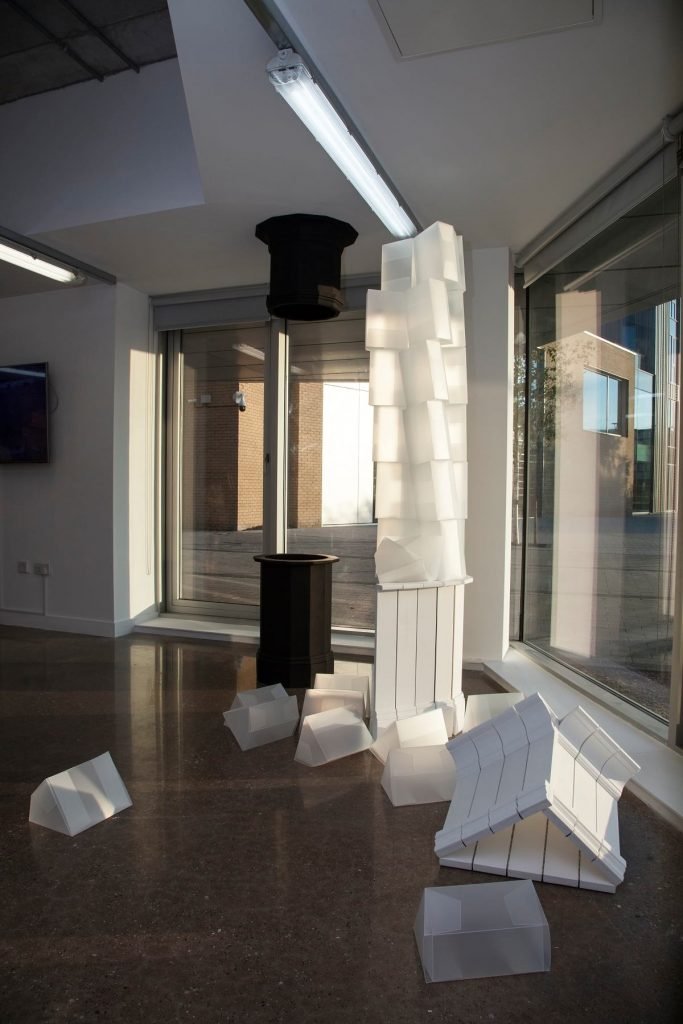
Flex, 2017
Materials: Wood, metal, paint, hinges, polypropylene
Dimensions: Variable
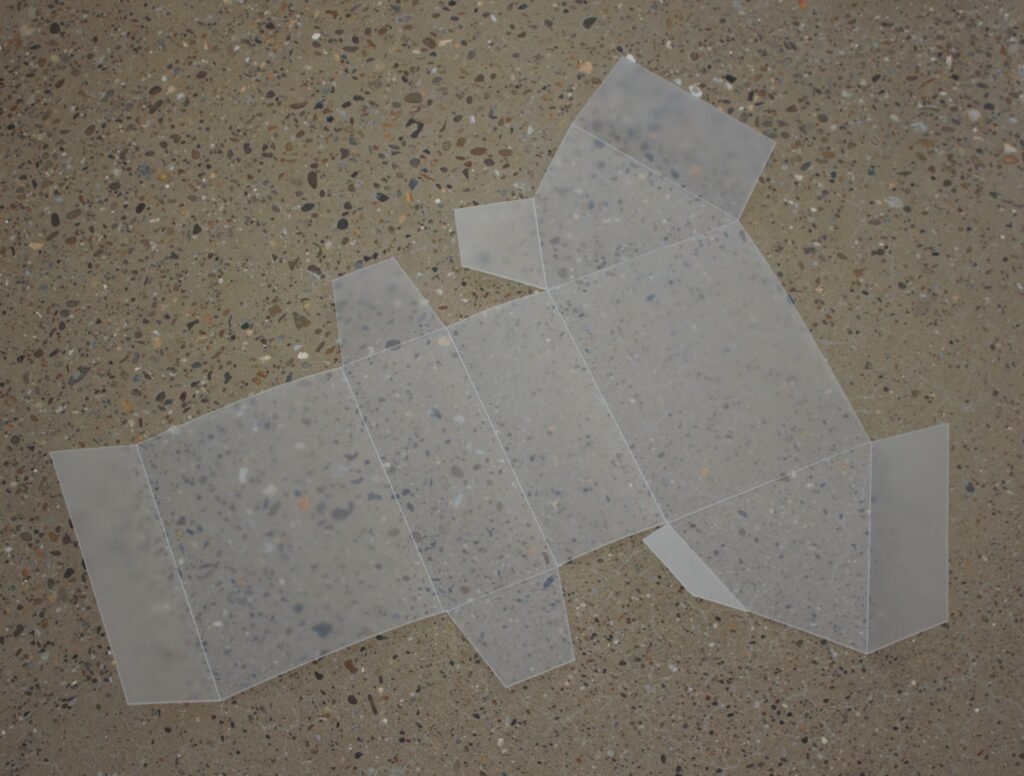
Flex, 2017 (detail)
Material: Polypropylene
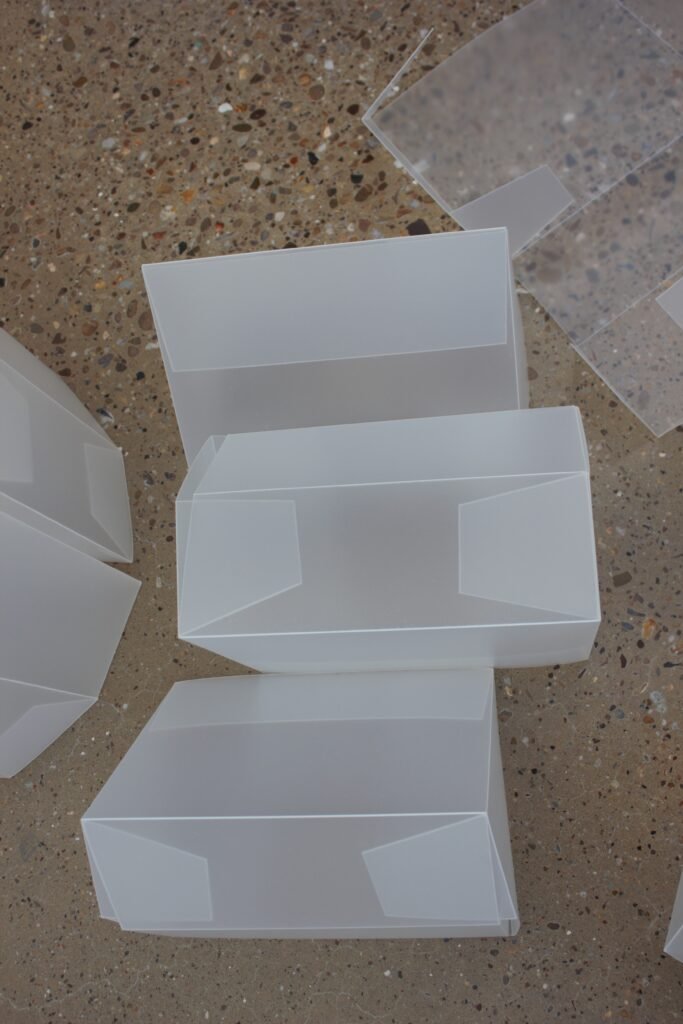
Flex, 2017 (detail)
Material: Polypropylene
Flex emerged from watching light and shadows dance across frosted windowpanes, and while reading about “grey areas”—first, in Hunter Vaughan’s Where Film Meets Philosophy, which explores how filmmakers use ambiguity to challenge what it means to think [1], and then in Susan Sontag’s essay The Aesthetics of Silence, which references how artists employ silence to evoke a sense of estrangement that invites open interpretation [2].
As an architectural experiment in cinematic thinking, Flex references the shifting frames of an empty celluloid film reel. Reimagining an internal wall, the work bends a grid of windowpanes into a cylindrical column, turning the traditional act of “looking out” inside-out.
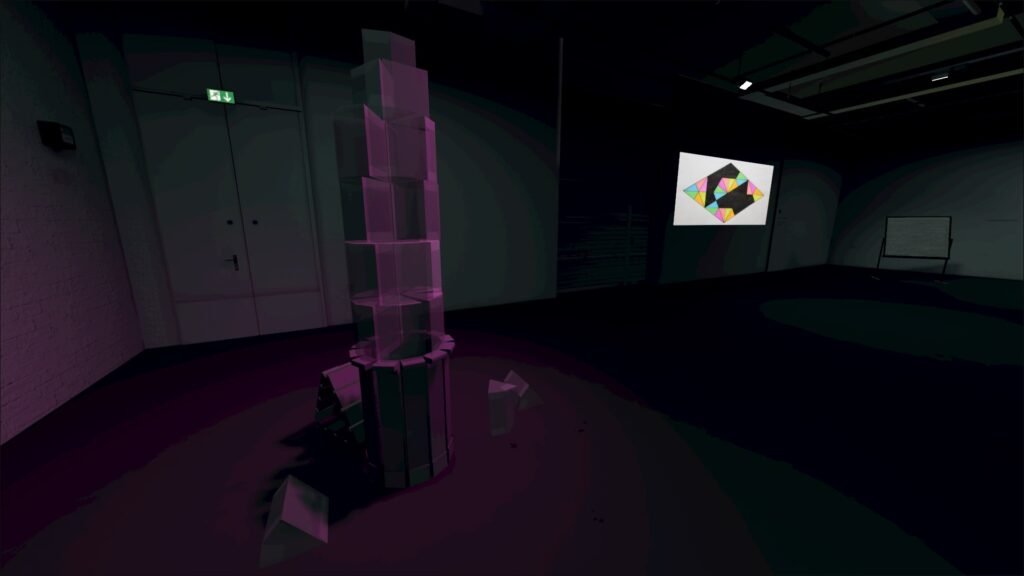
We Are Only Partly Real (Night Cycle, Zone 1 & 2), 2025
The accompanying image above is an installation shot from We Are Only Partly Real, a virtual reality exhibition produced in collaboration with artist Steve Dutton and digital VR specialist Stephen Gray, commissioned by Spike Island and funded by the University of Bristol’s AHRC Impact Acceleration Award.
In the virtual space of We Are Only Partly Real, Flex became an active object of reference to my Love by Proxy Series—a connection that occurred on discovering the top and bottom edges of each reformed windowpane perfectly matched the Heart and Mind symbols in my diagrammatic drawing series. In the VR “night cycle”, Flex’s cellular windowpanes channel the colour sequence in the drawings, framing colour as an act of perspective rather than a static property of an object or space.
[1] Vaughan, H. Where Film Meets Philosophy: Godard, Resnais, and Experiments in Cinematic Thinking, New York: Columbia University Press, 2013, p5-22
[2] Sontag, S. Styles of Radical Will., London: Secker & Warburg, 1969, p1-34